Yassine Benihadd
The ForgivenYassine Benihadd is a captain who responds to the fatal collision near Ksour Azna and speaks with Richard Galloway, David Henniger, and Jo Henniger in its aftermath. The brief scenes that define him move between official instruction and social courtesy: he controls how the scene is handled, then draws the shaken visitors into conversation. His assurance that the death will be recorded as accidental gives the incident an official disposition, even as the circumstances remain troubling to those present.
First Contact and the Collision
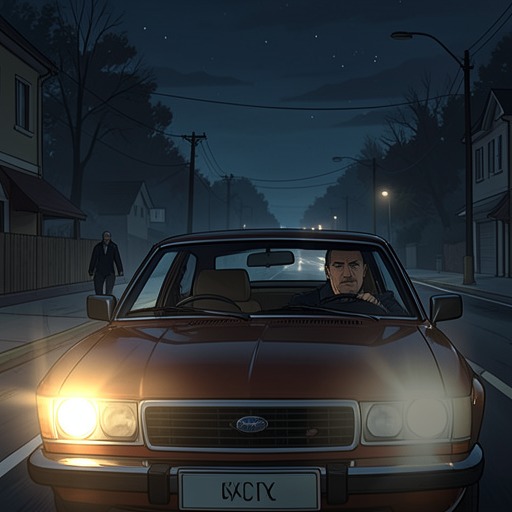
Richard calls the police from Ksour Azna, identifying himself on the phone as Richard Duddy. Yassine answers in French that Richard perceives as sluggish and slightly hostile, with uncertainties in its phrasing. His first question is whether Richard has been burgled, an ordinary possibility that the call quickly overturns. Richard explains that a man has been hit by a car and that the people there do not know him; the victim might be local. Yassine’s brief response acknowledges the bad news, but the exchange does not dwell on emotion. It moves toward managing the scene.
Yassine instructs Richard to keep everyone there and put the body somewhere cool. When Richard wonders whether the kitchen is meant, the practical direction has already exposed a gap between the police captain’s clipped instructions and the realities of handling a corpse at a guest house. Yassine adds a precise prohibition: the body must not be touched. Together, the instructions establish his immediate priorities as preserving the scene and maintaining control over those present. The narrative offers no account of how he reached these decisions; his authority is conveyed through what he tells Richard to do.
Questioning the Hennigers
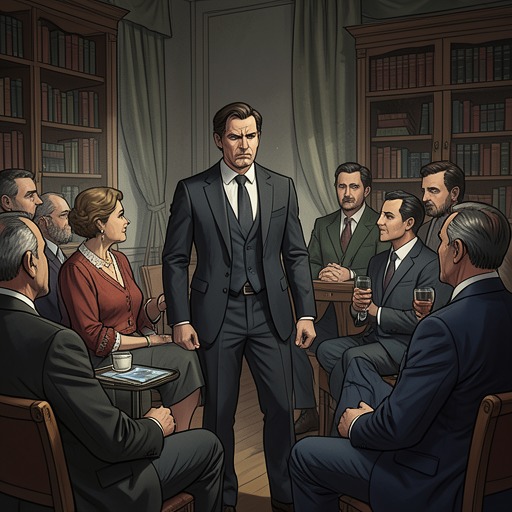
When David and Jo arrive at the open gate, Yassine is standing with Richard and a jug of iced lemonade. David is drenched with sweat, while Yassine looks him over with skeptical detachment. The contrast places the visitors’ physical distress beside the captain’s composed scrutiny. Yet Yassine’s manner is not simply severe: after examining David, he goes to Jo, kisses her hand, and addresses her courteously. This gesture sets a formal, almost ceremonious tone before he asks the couple to walk with him on the road outside.
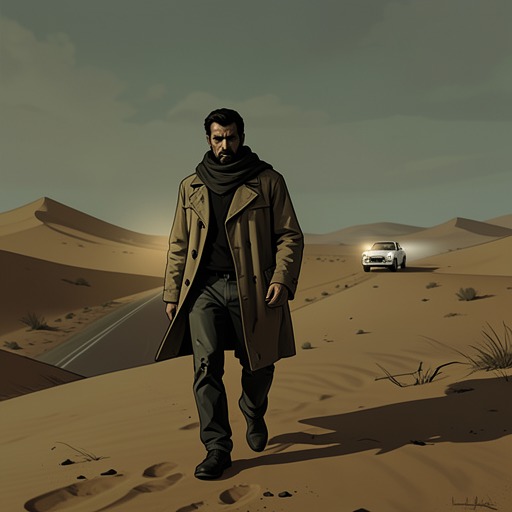
The walk takes place on the same road they had driven along only hours earlier. Yassine asks casual questions, adopting a courtly manner that makes refusal seem acceptable. He asks whether David has a practice in Chelsea and whether Jo writes children’s books. David’s professional background and Jo’s writing are thus drawn into the conversation without an overt accusation or a direct interrogation about the collision. Jo says that her books have not been very successful. The captain’s questions keep the encounter conversational, but their setting and timing give the exchange an investigative edge: he is speaking with the people whose journey has brought them back to the road where the man was struck.
Official Disposition and Narrative Role
Yassine later tells the Hennigers that the death will be recorded as accidental and hopes they can enjoy the rest of the weekend after what has happened. His formulation places an administrative conclusion beside a social reassurance. The death is not treated as a criminal case in the information he gives them; instead, he presents the official recording as settled and turns their attention toward continuing the weekend. Jo says she wants to sleep, but the moment does not develop into further discussion with the captain.
Yassine appears only in these short encounters, so the text does not establish his private motives or provide a fuller account of the investigation. His role is defined by the authority he exercises over the immediate aftermath: he orders the group to remain, directs them not to disturb the body, questions the visitors, and communicates the classification of the death. The contrast between his early instructions and his later courtesy makes his presence both practical and socially controlled. His decision to tell the Hennigers that the death will be recorded as accidental closes the official exchange, but it does not erase the narrative’s lingering uncertainty about what happened on the road.